

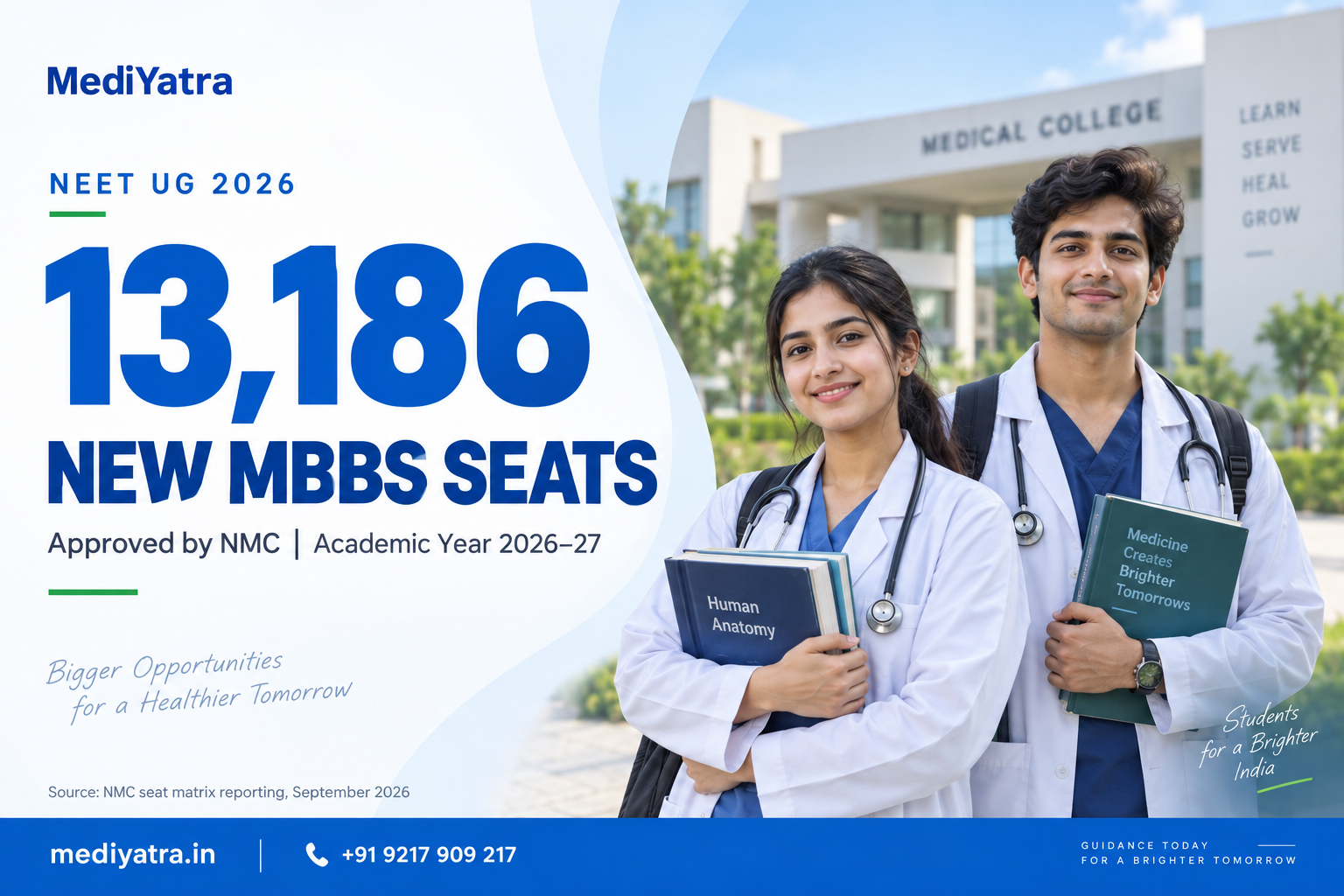
More MBBS seats can open up more choices. Here is what students and parents should understand about the reported expansion, college selection and counselling.
MediYatra • Updated 13 September 2026
The National Medical Commission has approved 13,186 additional MBBS seats for the 2026–27 academic year, according to reporting on its updated matrix. The published figures show 1,40,214 seats across 836 medical colleges, excluding Institutes of National Importance (INIs). The matrix is dated as on 1 September 2026.
For a family considering MBBS, the useful question is: which of these options fits the student’s rank, eligibility and budget? A larger national intake is encouraging, but it does not tell you which college you can obtain. That requires a closer look at the applicable counselling matrix.
Particular | Reported details |
|---|---|
Admission year | 2026–27 |
Renewed seats | 1,27,028 |
Additional seats | 13,186 |
Total intake covered | 1,40,214 |
Colleges covered | 836 |
Scope | Excludes INIs; subject to revision |
Management | Additional seats | Total seats |
|---|---|---|
Government | 2,786 | 63,971 |
Private | 10,400 | 76,243 |
Total | 13,186 | 1,40,214 |
Approximately 79% of the additional seats are in the private sector, calculated as 10,400 ÷ 13,186. For students targeting a government college, the government-seat increase is therefore the more relevant starting point. Private options deserve a separate affordability check.
Before adding a private college to your preferences, ask for its complete published fee schedule. Compare tuition, hostel, mess, deposits and any other compulsory charges. A seat that looks achievable on rank may still be unsuitable for the family’s planned expenditure.
State | Additional MBBS seats |
|---|---|
Karnataka | 1,650 |
Tamil Nadu | 1,250 |
Bihar | 1,240 |
Uttar Pradesh | 1,200 |
Rajasthan | 1,100 |
Telangana | 1,010 |
West Bengal | 975 |
Selected leading increases; this is not a complete state-wise list.
Treat this table as a starting point for research, rather than a ready-made college preference list. A large increase in a state does not establish your eligibility for its seats, the fees attached to them or the strength of its individual colleges. Check those details before widening your search.
The NMC matrix describes approved capacity. The counselling authority’s current matrix identifies the seats offered in a particular round. MCC separately publishes newly added seats, clear vacancies and virtual vacancies.
Do not assume that the entire national increase represents fresh vacancies still available to you. Confirm the college, course, quota and category in the relevant round before making a choice.
A nationwide seat increase cannot establish a specific cutoff reduction. As an admissions assessment, extra capacity may broaden options where it matches candidate demand. The effect can differ between colleges, categories, quotas and rounds; no numerical fall in marks or closing rank can be responsibly inferred from this announcement alone.
Separate two questions: whether you meet the examination’s qualifying requirement, and whether your rank can obtain a particular seat. The second question needs actual allotment evidence. For comparisons, use the same college, quota, category and counselling round wherever possible.
If a newly participating college has no comparable previous closing rank, treat its admission chances as uncertain. Avoid assigning it a “safe” label simply because it is new. Keep an achievable range of acceptable preferences while retaining options you would genuinely be willing to join.
Use a simple college-by-college review before editing your preferences:
MCC’s scheme covers 15% All India Quota seats and specified institutional routes, including deemed universities, AIIMS and JIPMER. State counselling is a separate route for seats administered by the respective state authority. Eligibility is route-specific; the national increase does not make every seat available through MCC.
Make a separate shortlist for each counselling route you plan to use. Note its official portal, registration requirements, fee information and deadlines. This helps prevent an otherwise suitable college from being missed because it belongs to a different process.
For current MCC announcements, use . For a state-administered seat, consult that state’s designated medical counselling authority.
The notice, reproduced by Medical Dialogues, allows subsequent revisions following competent-authority decisions. It also requires pending e-bank guarantees from relevant private colleges before their Letters of Permission are issued after verification. Admissions must remain within the approved intake.
For your own shortlist, verify permission status and the current counselling listing together. If the records appear inconsistent, seek clarification from the counselling authority before acting on an admission offer.
Your college decision should reflect your rank, category, eligibility, preferences and budget. MediYatra helps students and parents understand medical admission options and plan their counselling decisions with clarity.
For free counselling, contact MediYatra. Guidance does not guarantee admission; allotment depends on the applicable rules, merit and available seats.
No. The reported expansion includes both government and private colleges. Review the management-wise table above before assessing which options fit your budget.
No. An individual allotment requires the relevant merit position, eligibility, preferences and seat availability. The announcement alone cannot support a promised score or rank.
First confirm that the relevant seat appears in your counselling round and that you meet its eligibility conditions. Then assess whether you would be willing and able to join.
Do not base that decision on a headline. Review the applicable resignation or upgrade rules, your existing allotment and the specific alternative before taking action.
Use the NMC notices page for regulatory updates and the relevant MCC or state counselling portal for round-specific availability.
The seat figures above are based on accessible reporting of the NMC matrix. The original NMC PDF could not be retrieved for direct inspection. Conflicting government/private college counts in secondary reports have therefore been omitted. Figures describe the dated matrix, not a live vacancy total.
The correct arithmetic is 1,27,028 + 13,186 = 1,40,214. The “1,40,124” figure in the Medical Dialogues headline conflicts with its own table and is not used here.
Mediyatra is a medical education consultancy focused on helping students and medical aspirants understand admission opportunities, counselling processes and medical education pathways in India and abroad.
For more guidance, visit our website. Our aim is to provide students with useful, transparent and student-focused information so that they can make informed decisions regarding their medical education journey.

Fill in the basic details. Our counsellor will get in touch with you.
2nd Floor, Plot No. 4 Minarch Tower,
Sector - 44 Gurgaon,
Haryana - 122 003

