
📌 QUICK POLICY OVERVIEW
Before reading the complete article, here's a quick overview of the biggest developments regarding India's doctor registration policy.
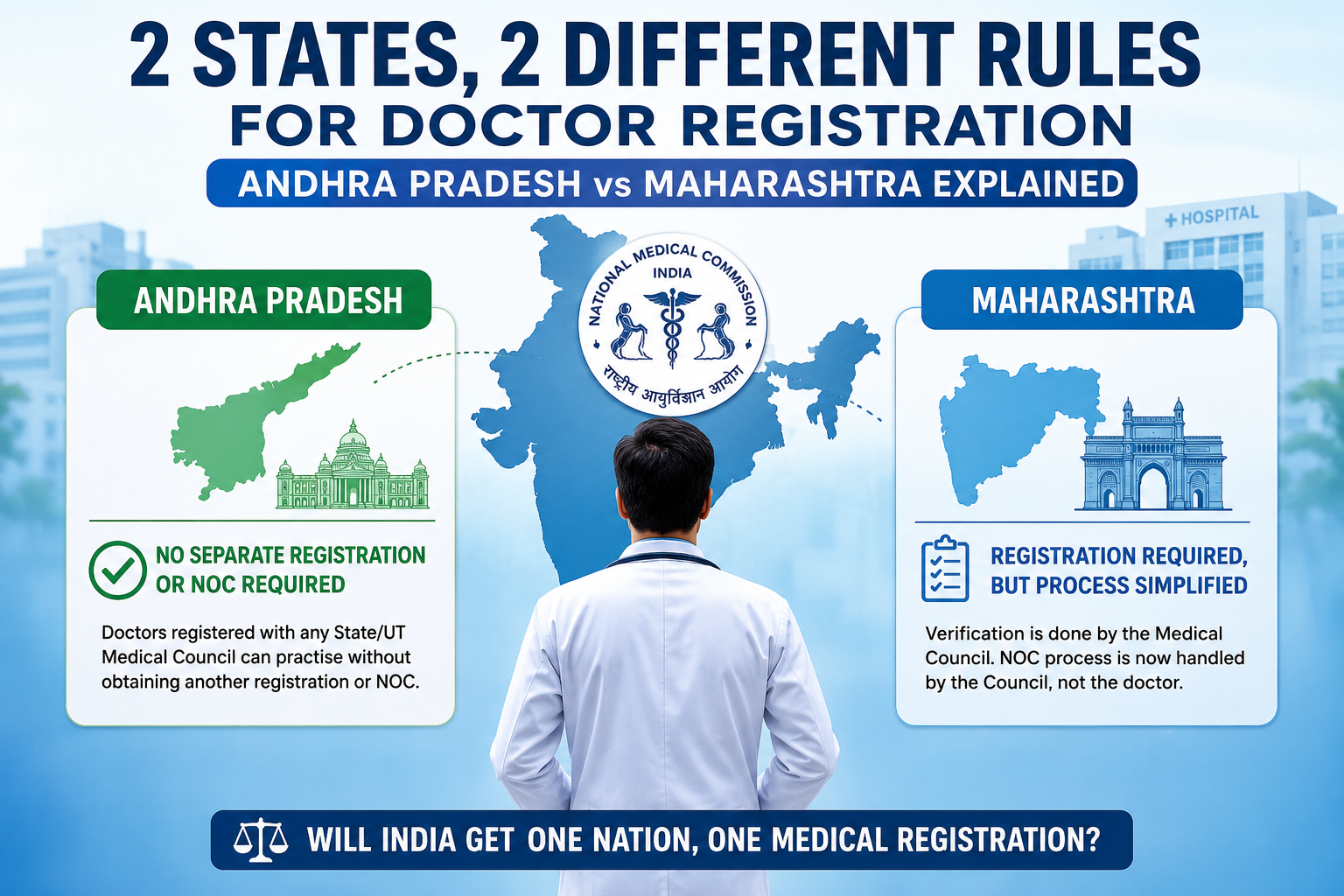
🏛️ Andhra PradeshDoctors registered with any State or Union Territory Medical Council can now practise in Andhra Pradesh without obtaining another registration or No Objection Certificate (NOC). ✅ Registration Barrier Removed | 📄 MaharashtraDoctors no longer need to collect an NOC themselves. However, the Maharashtra Medical Council continues verification before granting registration. 🛡️ Verification Still Mandatory |
🏥 National Medical CommissionThe National Medical Commission (NMC) is examining whether India should adopt a nationwide doctor registration system, especially for Armed Forces doctors who are frequently transferred. ⚡ National Reform Under Discussion | ⚖️ The Big DebateCan India simplify interstate medical practice while maintaining patient safety, accountability and proper verification? This is now one of the biggest healthcare policy discussions in the country. 🇮🇳 One Nation • One Registration? |
This policy change is not just another administrative update. If India eventually adopts a single nationwide medical registration framework, it could significantly reduce paperwork for doctors, improve workforce mobility across states, and make emergency deployments easier. However, experts also stress that verification and accountability must remain strong to protect patient safety.
📅 POLICY TIMELINE
Within just a few days, two Indian states announced completely different approaches for doctor registration. These decisions have now triggered a nationwide discussion.
The Maharashtra Medical Council simplified the registration process by removing the requirement for doctors to obtain a No Objection Certificate (NOC) themselves. Instead, the Council now directly contacts the parent State Medical Council for verification before issuing provisional registration.
Andhra Pradesh introduced a much more liberal policy. Doctors already registered with any State Medical Council or Union Territory Medical Council can now practise in Andhra Pradesh without obtaining another registration or NOC.
Following these contrasting policies, the National Medical Commission (NMC) is examining whether India should move towards a single nationwide registration system, particularly for Armed Forces doctors who frequently serve across different states.
This isn't simply about reducing paperwork. The real challenge is finding the right balance between making interstate medical practice easier for qualified doctors and ensuring patient safety through proper verification. Andhra Pradesh has prioritised ease of mobility, while Maharashtra has focused on maintaining regulatory oversight. The NMC now has an opportunity to combine the strengths of both models into a unified national framework.
🏛 ANDHRA PRADESH REFORM
On 11 June, Andhra Pradesh introduced one of the most liberal doctor registration policies in India. The state announced that any doctor already registered with a State Medical Council or Union Territory Medical Council can practise in Andhra Pradesh without applying for a separate state registration or obtaining a No Objection Certificate (NOC).
✅ What's Changed?
| 🚀 Potential Benefits
|
While Andhra Pradesh has simplified the registration process, experts believe that any nationwide model should still include robust verification mechanisms to protect patient safety and maintain professional accountability.
For current MBBS students and future doctors, Andhra Pradesh's approach signals a possible shift towards greater professional mobility. If similar reforms are adopted nationally, newly qualified doctors may find it easier to work in different states without going through multiple registration procedures. However, the final framework will depend on future decisions by the National Medical Commission.
For verified updates on medical registration policies, students and doctors should always refer to official sources instead of relying on social media rumours.
📍 MAHARASHTRA MEDICAL COUNCIL
Unlike Andhra Pradesh, Maharashtra has chosen a balanced regulatory model. Instead of removing registration requirements completely, it has simplified the process by eliminating the need for doctors to obtain a No Objection Certificate (NOC) themselves while continuing verification through the Medical Council.
📄 Step 1Doctors submit their registration application directly to the Maharashtra Medical Council. | 🔍 Step 2Instead of asking doctors to obtain an NOC, the Council itself contacts the parent Medical Council for verification. | ✅ Step 3Doctors receive provisional registration while verification continues, reducing unnecessary delays. |
Medical registration is not only about allowing doctors to practise. It is also about ensuring patient safety, checking professional credentials and preventing fraudulent registrations. Maharashtra believes that simplifying paperwork should not come at the cost of regulatory accountability.
This model attempts to balance convenience with accountability. Doctors no longer need to visit multiple Medical Councils for paperwork, while authorities continue to verify registration records before granting full approval.
Maharashtra's policy is not about making registration harder. Instead, it shifts the responsibility of verification from doctors to the Medical Council, making the process more efficient while maintaining professional standards.
⚖️ POLICY COMPARISON
Although both states want to simplify interstate medical practice, their methods are completely different. Here's a side-by-side comparison to understand the key differences.
🏛 Andhra Pradesh✅ Separate Registration : Not Required ✅ NOC : Not Required ✅ Interstate Practice : Immediate ✅ Paperwork : Minimal 🎯 Main Objective : Doctor Mobility | 📋 Maharashtra✅ Registration : Required ✅ NOC : Council Handles It ✅ Verification : Mandatory ✅ Provisional Registration : Available 🎯 Main Objective : Patient Safety |
Feature | Andhra Pradesh | Maharashtra |
|---|---|---|
Separate Registration | ❌ No | ✅ Yes |
NOC Required | ❌ No | Council Manages |
Verification | Limited | Complete |
Main Focus | Easy Practice | Safety & Accountability |
Suitable For | Fast Interstate Mobility | Regulated Medical Practice |
📊 POLICY ANALYSIS
Both policies aim to improve healthcare delivery, but each follows a different philosophy. One focuses on faster doctor mobility, while the other prioritises verification and patient safety.
✅ Major Advantages
| ⚠ Possible Challenges
|
Many healthcare experts agree that reducing unnecessary paperwork is a positive step for doctors. However, they also believe that professional verification, disciplinary records and registration authenticity should continue to be checked before allowing medical practice in another state. In simple words, the process can become easier, but accountability should remain unchanged.
The real debate is not whether doctors should be allowed to practise across states—it is how India can make interstate practice simpler without weakening verification standards. Andhra Pradesh has shown what a low-barrier system looks like, while Maharashtra demonstrates how administrative reforms can coexist with regulatory oversight. A future nationwide framework may combine the strengths of both approaches.
🎯 WHO WILL BE IMPACTED?
A nationwide doctor registration framework would not affect only doctors—it could transform hospitals, medical students, patients and the overall healthcare system.
🎓 MBBS Students & NEET AspirantsStudents planning their medical careers could benefit from greater flexibility after graduation. Instead of applying for multiple state registrations, they may eventually be able to practise across India through a simpler system if such reforms are implemented nationwide. | 👨⚕ Practising DoctorsDoctors who relocate for employment, higher education or family reasons could experience fewer administrative hurdles. Faster registration may reduce delays in joining hospitals and beginning clinical work. |
🏥 Hospitals & Healthcare InstitutionsHospitals may recruit specialists from different states more efficiently. This can be particularly valuable in rural areas and during public health emergencies when medical manpower is urgently required. | ❤️ PatientsPatients could benefit from improved access to qualified doctors, provided that verification and regulatory checks remain strong. Easier mobility should always be balanced with patient safety and accountability. |
The idea is gaining attention because it could simplify interstate practice for qualified doctors. However, any national framework would still need secure verification, updated digital records and coordination between the National Medical Commission and State Medical Councils. As of now, the proposal is under discussion and no nationwide system has been officially implemented.
The debate is no longer just about paperwork—it is about creating a healthcare system where qualified doctors can move more easily while ensuring that every practising professional is properly verified. The decisions taken today by Andhra Pradesh and Maharashtra may shape the future of medical regulation across India.
❓ FREQUENTLY ASKED QUESTIONS
Here are answers to the most common questions students, doctors and healthcare professionals may have about the latest doctor registration policy changes.
No. As of now, India has not introduced a nationwide medical registration system. The National Medical Commission (NMC) is examining the idea, but no official nationwide framework has been implemented.
Doctors already registered with any State or Union Territory Medical Council can practise in Andhra Pradesh without obtaining another state registration or NOC.
Doctors no longer need to obtain an NOC themselves. The Maharashtra Medical Council directly verifies records with the parent council while granting provisional registration.
No. These reforms relate to the registration of qualified doctors and do not change the NEET UG admission process.
Always rely on official government and regulatory websites for the latest updates on doctor registration and medical education.
The contrasting decisions taken by Andhra Pradesh and Maharashtra have sparked an important national discussion on the future of doctor registration in India. Andhra Pradesh has chosen to prioritise ease of mobility, while Maharashtra has focused on maintaining verification and accountability. As the National Medical Commission evaluates broader reforms, any future nationwide framework is likely to seek a balance between administrative simplicity and patient safety.
For doctors, MBBS students and NEET aspirants, these developments are worth following closely. However, until any official national policy is announced, registration requirements will continue to depend on the applicable rules of each state and the decisions of the relevant medical authorities.
This article is intended for educational and informational purposes only. It is based on publicly reported information and the policy details shared in the news. Readers should always verify the latest rules and notifications through the official websites of the National Medical Commission and the relevant State Medical Councils before making any professional or legal decisions.
🚀 NEVER MISS AN UPDATE
From NEET UG, NEET PG, FMGE, NExT, MBBS Admissions, Medical Colleges, NMC Notifications and Career Guidance — MediaYatra brings verified and student-friendly updates in one place.
Continue reading our latest healthcare and medical education coverage.
🩺 NMC Latest Guidelines ExplainedUnderstand the latest National Medical Commission regulations in simple language. | 🎓 NEET 2026 Latest UpdatesLatest counselling news, answer keys, results and admission updates. | 🌍 Study MBBS Abroad GuideCompare Russia, Georgia, Kazakhstan and other countries for MBBS. |
M | About MediaYatraMediaYatra is dedicated to delivering verified news, in-depth analysis, and trusted guidance for NEET aspirants, MBBS students, doctors, and parents. Our goal is to simplify complex healthcare and medical education updates into clear, reliable, and easy-to-understand articles. |
Share this article with your friends, classmates, MBBS students and fellow doctors so they stay informed about the latest healthcare policy changes.
🏛 EXPERT OPINION
The discussion around interstate doctor registration is not only taking place among governments and regulators—it is also being closely watched by the Indian Medical Association (IMA), one of the country's largest organisations representing medical professionals.
According to IMA President Dr. Anil Kumar J. Nayak, simplifying the registration process is a positive reform because it reduces unnecessary administrative hurdles for doctors. However, he also emphasised that verification, transparency and professional accountability should never be compromised.
In simple terms, the IMA supports reducing paperwork but believes every practising doctor must still undergo proper verification to maintain patient trust and healthcare quality.
The IMA's perspective is significant because it reflects the concerns of practising doctors across India. Their recommendations may influence how future nationwide registration reforms are designed by the National Medical Commission.
🇮🇳 FUTURE OF HEALTHCARE
The contrasting decisions taken by Andhra Pradesh and Maharashtra have triggered a much larger national conversation. Policymakers, medical professionals and healthcare experts are now discussing whether India should move towards a single, digitally verified medical registration system that allows doctors to practise across the country while maintaining patient safety.
🚀 Possible Benefits
| 🛡️ Challenges to Address
|
If the National Medical Commission eventually introduces a nationwide registration framework, newly qualified doctors may no longer need to complete separate registration formalities every time they move to another state. Instead, a secure digital verification process could allow eligible doctors to practise more efficiently while preserving patient safety through centralised records and regulatory oversight.
However, it is important to remember that no nationwide policy has been officially announced yet. Until then, doctors must continue following the registration requirements issued by the respective State Medical Councils and the National Medical Commission.
For NEET aspirants and MBBS students, this discussion is worth following because any future changes in doctor registration could influence career mobility after graduation. While admissions and licensing processes remain unchanged today, future reforms may simplify how doctors begin their professional careers in different parts of India.
📊 QUICK FACTS
Here's a quick summary of the most important points from this policy debate.
🏛 Andhra PradeshNo separate registration or NOC required for doctors already registered with any State/UT Medical Council. | 📋 MaharashtraVerification remains mandatory, but the Medical Council now manages the NOC process. | ⚖️ Main DebateDoctor mobility versus regulatory verification and patient safety. | 🇮🇳 NMCA nationwide registration framework is under discussion but has not been implemented. |
✔ India currently follows a state-based medical registration system, meaning doctors generally need to comply with the rules of the state where they wish to practise.
✔ Armed Forces doctors are among the professionals whose frequent transfers have strengthened discussions around a more flexible national registration system.
✔ Any future nationwide system would still require verification mechanisms to maintain public trust in healthcare.
Term | Meaning |
|---|---|
NOC (No Objection Certificate) | A document previously required by many State Medical Councils before allowing doctors to register in another state. |
State Medical Council | The statutory authority responsible for registering and regulating doctors within a particular state. |
Provisional Registration | A temporary registration issued while verification or formalities are being completed. |
National Medical Commission (NMC) | India's apex medical education and medical profession regulator responsible for setting national standards. |
The future of doctor registration in India will likely depend on finding the right balance between easy interstate practice and strong verification for patient safety.
🏆 MEDIA YATRA EDITOR'S VERDICT
The recent decisions taken by Andhra Pradesh and Maharashtra clearly show that India's medical registration system is evolving. While one state has prioritised doctor mobility, the other continues to emphasise verification and accountability. Instead of choosing one model over the other, the future may lie in combining both approaches into a secure, technology-driven national framework.
A quick snapshot of everything discussed in this article.
🏛 Andhra PradeshDoctors registered with any State or UT Medical Council can practise without obtaining another registration or NOC. | 📋 MaharashtraRegistration remains compulsory, but verification is handled directly by the Medical Council instead of the doctor. | 🇮🇳 National OutlookThe National Medical Commission is evaluating future reforms, but no nationwide registration framework has been officially introduced yet. |
The debate is no longer about whether doctors should be allowed to work across states—it is about building a registration system that is modern, transparent, secure and patient-centric. The policies introduced in Andhra Pradesh and Maharashtra could become the foundation of India's future medical regulatory framework.
Healthcare policies should never force doctors to choose between mobility and accountability. The strongest system is the one that protects patients while empowering qualified professionals to serve wherever they are needed.
— MediaYatra Editorial Team
✅ Verified Medical News | ✅ Official Government Sources |
✅ Student-Friendly Explanations | ✅ Regular NMC & NEET Updates |
✅ MBBS Abroad Guidance | ✅ Trusted Educational Content |
Get trusted updates on NEET UG, NEET PG, FMGE, MBBS Abroad, NMC Notifications, Medical Colleges, Counselling and Healthcare Policies — all in one place.
Delivering trusted medical education news, policy analysis and career guidance for future doctors across India.
© 2026 MediaYatra. All Rights Reserved.

Fill in the basic details. Our counsellor will get in touch with you.
2nd Floor, Plot No. 4 Minarch Tower,
Sector - 44 Gurgaon,
Haryana - 122 003